

A Generational Shift Is About to Reshape the Housing Market

 A new study from First American suggests the U.S. housing market is on the edge of a major demographic transition—one that will unfold over the next several decades. Millennials are now in their prime homebuying years, Gen Z is right behind them, and even younger groups (Generations Alpha and Beta) will eventually add to long-term housing demand.
At the same time, most of today’s housing inventory is still owned by baby boomers—many of whom are “aging in place.” That means turnover is low right now, especially for larger family homes in popular cities. But as boomers eventually downsize, move for care, or pass properties to heirs, we’ll see a slow but steady release of inventory back into the market.
Boomers & Gen X: The First Leg of the Housing Relay
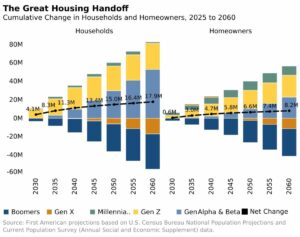
Boomers and Gen X currently hold the bulk of owner-occupied homes. In 2025, boomers are estimated to own nearly 40 million homes with a high homeownership rate of 78%. Many are staying put thanks to fully or mostly paid-off mortgages and technology that makes independent living easier.
But this won’t last forever. Over the next 30+ years, health needs and lifestyle changes will gradually shift these owners into smaller or care-oriented settings. By 2060, the number of boomer-owned households will fall sharply, opening the door to millions of larger, well-located homes becoming available to younger buyers.
Gen X, the “middle child” generation, is smaller but still significant. Over the next two decades, they’ll remain in peak earning years and continue buying. As they age into retirement, they’ll eventually contribute to the same inventory release that boomers are beginning.
Millennials & Gen Z: Demand Builds for Decades
Millennials—the largest adult generation—are hitting their stride as homeowners. Between 2025 and the early 2050s, the number of millennial homeowners is expected to jump by more than 10 million as their homeownership rate rises from 51% to 73%. This creates a long tailwind for housing demand stretching well into the 2050s.
Gen Z is just beginning their housing journey. Their household numbers will grow rapidly over the next 20 years, and by 2060, their homeownership rate is projected to reach around 66%. As they move through their career and family-formation years, they’ll become the dominant force in the market.
And behind them? Generations Alpha and Beta, who will start entering the market in the 2030s and ramp up strongly by the 2050s—just as millennial demand begins to cool.
A Market Defined by Slow, Steady Shifts
From 2025 to 2060, the study projects the number of U.S. households will grow by nearly 18 million, with more than 8 million of those becoming homeowners. Instead of a sudden boom or bust, the housing market will experience a long, gradual “relay” where older generations slowly release homes and younger generations steadily step in as buyers.
What This Means for Buyers and Sellers
Over the coming decades:
-
Boomers and Gen X will gradually become net sellers.
-
Millennials and Gen Z will remain major sources of demand for years.
-
Prime neighborhoods and family homes will open up as older owners transition out.
For homebuyers—especially first-timers—this shift represents opportunity. And for sellers, especially those with well-located or family-sized homes, demand should stay strong for the foreseeable future.
Houses that are priced, presented & marketed correctly are selling fast.
Let my 30+ years of Real Estate experience in Las Vegas work for you. 702-378-705
The information contained, and the opinions expressed, in this article are not intended to be construed as investment advice. Very Vintage Vegas does not guarantee or warrant the accuracy or completeness of the information or opinions contained herein. Nothing herein should be construed as investment advice. You should always conduct your own research and due diligence and obtain professional advice before making any investment decision. Very Vintage Vegas, will not be liable for any loss or damage caused by your reliance on the information or opinions contained herein.