

2025 Home Buyers and Sellers Highlights
 The 2025 real estate market is officially a “tale of two cities.” According to the latest National Association of REALTORS® (NAR) Profile of Home Buyers and Sellers, we are seeing record-breaking extremes on both ends of the spectrum.
While some buyers are walking into deals with all-cash offers and massive equity, others—particularly first-time buyers—are facing the toughest hurdles in decades.
Here’s a breakdown of the 2025 trends and what they mean for you, whether you’re looking to buy your first home or sell your long-term residence.
1. The “First-Timer” Crisis
First-time buyers now make up just 21% of the market—the lowest share since NAR began tracking in 1981. To put that in perspective, before 2008, first-timers usually made up about 40% of sales.
-
The Age Factor: The median age of a first-time buyer has climbed to a record 40 years old. In the 1980s, that number was in the late 20s.
-
The Why: High rents and student loan debt are making it nearly impossible for younger generations to save. Delaying homeownership until age 40 can mean missing out on roughly $150,000 in potential equity.
2. All-Cash is King
On the flip side, all-cash home purchases have reached an all-time high of 26%. These “power buyers” are often repeat buyers who have built up significant equity in their previous homes. Over the last five years alone, the typical homeowner has gained an average of $140,900 in wealth just through home appreciation.
3. Down Payments are Sky-High
If you feel like you need more cash to compete, you’re right.
-
First-time buyers: Median down payment is 10% (the highest since 1989).
- Repeat buyers: Median down payment is 23% (the highest since 2003).
With higher interest rates, buyers are putting more money down to keep their monthly payments manageable.
4. We’re Staying Put Longer
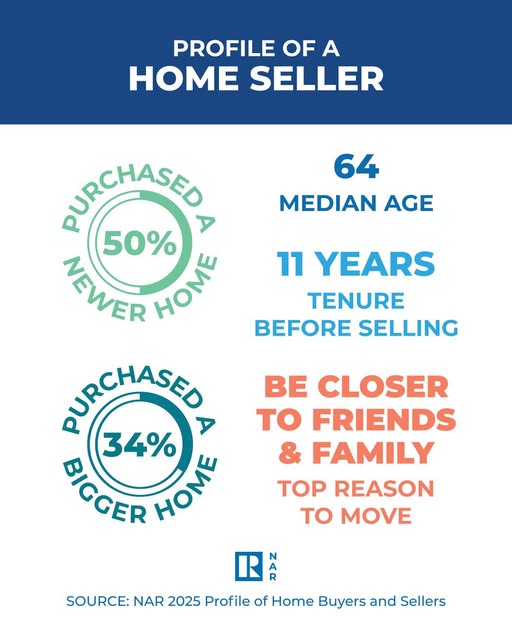
The “starter home” mentality is fading. The typical seller in 2025 had lived in their home for 11 years before selling—a record high.
-
The “Forever Home” Trend: New buyers now expect to live in their homes for at least 15 years, and 28% say they never intend to move again. People are buying for the long haul, prioritizing lifestyle and proximity to family over a short commute to the office.
5. Demographics are Shifting
The “traditional” nuclear family is no longer the primary driver of the market.
-
Fewer Kids: Only 24% of buyers have children under 18 at home—a historic low (down from 58% in 1985).
-
Single Buyers: Single women now make up 21% of the market, while single men account for 9%.
-
The Silver Tsunami: The median age of all buyers is now 59, and the typical seller is 64. Baby boomers are currently the most powerful force in real estate.
6. New Construction is Gaining Ground
Because existing inventory remains tight, more buyers are turning to new builds. New home purchases rose to 16% of the market. Why? Buyers want to avoid the “fixer-upper” headache and are taking advantage of builder incentives like mortgage rate buydowns and price reductions.
7. The Value of an Agent is at an All-Time High
Despite the abundance of online data, consumers are leaning on professionals more than ever.
-
88% of buyers and 91% of sellers used a real estate agent this past year.
- FSBO (For Sale By Owner) hit a record low of just 5%.
The data shows why: Agent-assisted homes sold for a median of $425,000, while FSBO homes sold for a median of $360,000. That’s a $65,000 difference that more than covers the cost of professional representation.
What This Means For You
If you’re a Buyer: It’s a competitive landscape, but you don’t have to go it alone. 76% of first-time buyers credited their agent with helping them navigate the complex process. If you’re struggling with a down payment, ask your agent about state-specific assistance programs or FHA/VA options that are designed to help first-timers.
If you’re a Seller: You are sitting on a record amount of equity. However, with buyers being older and more “intentional,” pricing and marketing are everything. Buyers are looking for neighborhood quality and move-in-ready conditions.
The Bottom Line: The 2025 market is complex, but for those who can navigate the “extremes,” it remains the primary way to build long-term wealth.
Curious about how these national trends affect our local market? Reach out today for a custom valuation of your home or a consultation on your next move!
Houses that are priced, presented & marketed correctly are selling fast.
Let my 30+ years of Real Estate experience in Las Vegas work for you. 702-378-705
The information contained, and the opinions expressed, in this article are not intended to be construed as investment advice. Very Vintage Vegas does not guarantee or warrant the accuracy or completeness of the information or opinions contained herein. Nothing herein should be construed as investment advice. You should always conduct your own research and due diligence and obtain professional advice before making any investment decision. Very Vintage Vegas, will not be liable for any loss or damage caused by your reliance on the information or opinions contained herein.