

 On November 22, 1995, Martin Scorsese’s Casino opened in theaters, giving moviegoers a look at the mob-connected Las Vegas of the 1970s and early 1980s. Robert De Niro, Sharon Stone, and Joe Pesci brought the story to life, but the real people behind those characters were already part of Las Vegas history.
And so were their homes.
Thirty-one years later, some of those houses are still standing, including several in our beloved Vintage Vegas neighborhoods. There’s even a connection between the actual home of Frank “Lefty” Rosenthal, the house used in the movie, and a former neighbor who happened to be Howard Hughes’s right-hand man.
You couldn’t make up some of this stuff. Well, Hollywood could, but the real stories are often just as fascinating.
The Real Lefty Rosenthal House
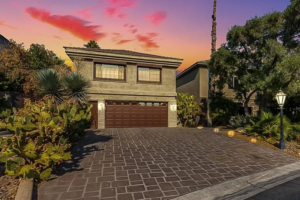
The former Las Vegas home of Frank “Lefty” Rosenthal, whose life inspired Robert De Niro’s character in the 1995 movie Casino.
Frank “Lefty” Rosenthal was the inspiration for Robert De Niro’s character, Sam “Ace” Rothstein. Rosenthal was a major figure in the Las Vegas casino business during the city’s mob era, and his personal life provided plenty of material for the movie.
His former home at 972 Vegas Valley Drive in the Las Vegas Country Club was built in the 1970s. At approximately 3,266 square feet, the house had some unusual features, including bullet-resistant doors and windows, soundproof rooms, mirrored ceilings, and a swimming pool.
Not exactly your typical suburban tract home.
In September 2008, Jack attended an Untold Stories presentation about the Las Vegas mob. During the question-and-answer portion, the subject of where various mob figures had lived came up.
Someone in the audience called out, “We live in Lefty Rosenthal’s house!”
Naturally, that got Jack’s attention.
After the presentation, he met Jeff and Sheri, the homeowners, who turned out to be regular Very Vintage Vegas readers. They had purchased the property in 2003 and were working on renovations. They even invited Jack to visit once the work was completed.
Jack wrote about the encounter on September 5, 2008, along with some of the historical events connected to the house.
Read Jack’s original 2008 story about the Las Vegas mob and the Rosenthal house.
Years later, Realtor.com featured the house when it came on the market, giving readers a look inside one of Las Vegas’s more unusual historical residences.
See Realtor.com’s feature on Lefty Rosenthal’s former home.
But Wait. The Casino Movie House Was in Paradise Palms!
Here’s where the story gets especially interesting for those of us who love Vintage Vegas.
The house used for the Rothstein family’s home in Casino wasn’t Rosenthal’s actual residence.
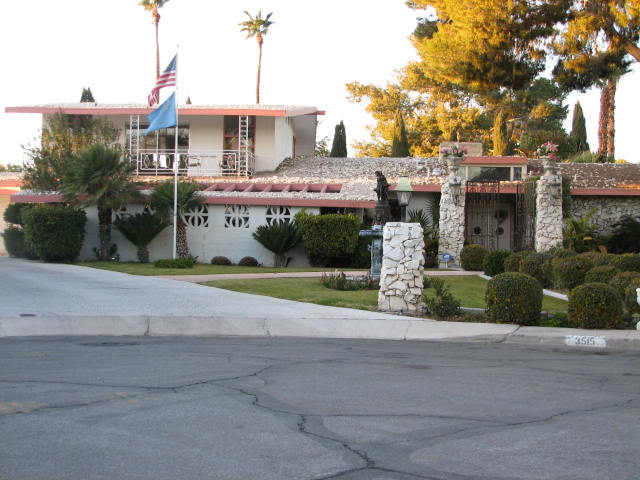
Hollywood chose 3515 Cochise Lane in Paradise Palms, overlooking the Las Vegas National Golf Course.
The distinctive custom home provided the setting for scenes involving Robert De Niro and Sharon Stone, and it has been known locally as the Casino house ever since.
Long before the movie, the property was associated with Ash Resnick, a Caesars Palace executive with connections to the gaming world.
It’s one of the many custom residences that make Paradise Palms such an interesting neighborhood. The community was developed beginning in 1960, and its architectural variety, golf course settings, and notable former residents have long distinguished it from the typical Las Vegas subdivision.
As it turns out, Rosenthal himself also has a Paradise Palms connection. Historical neighborhood accounts identify 3572 Spencer Street as another address associated with him.
So the real story stretches beyond one house and one movie location.
And Who Lived Next Door to the Casino House?
As if that weren’t enough Las Vegas history for one street, the neighboring house at 3525 Cochise Lane belonged to Robert Maheu.
Maheu was Howard Hughes’s longtime representative and managed many of Hughes’s extensive Nevada business interests. He was an important figure during the years when Hughes was buying Las Vegas hotels and casinos and transforming the city’s business landscape.
One of the more remarkable details of their relationship was that Maheu managed Hughes’s affairs for years without ever meeting him face-to-face.
In January 2009, Jack wrote about Maheu’s former Paradise Palms home when it was offered for lease.
The property had four bedrooms, four bathrooms, and nearly 4,000 square feet of living space. At the time, the asking rent was $2,495 per month.
Jack pointed out that Maheu’s house was right next door to the famous Casino filming location.
Think about that for a moment.
Two neighboring homes in a quiet residential section of Paradise Palms, one connected to Howard Hughes’s business empire and the other immortalized in a Martin Scorsese movie about Las Vegas’s mob era.
That’s a pretty remarkable amount of history for one block.
Read Jack’s January 2009 article about Robert Maheu’s Paradise Palms home.
The Las Vegas History That Didn’t Get Demolished
We spend a lot of time talking about the historic hotels and casinos that have disappeared from the Strip. The Stardust, the Desert Inn, the Riviera, and so many others are now memories, photographs, and stories.
But much of the history of the people who built, operated, entertained, and sometimes caused trouble in those places survives in our residential neighborhoods.
Paradise Palms was home to entertainers, casino executives, business leaders, and other colorful personalities from an era when Las Vegas was a much smaller town.
The Las Vegas Country Club, Scotch 80s, Rancho Circle, and other established neighborhoods have their own collections of stories. Some are famous, some are forgotten, and others are still being discovered.
That’s one of the things we’ve always loved about Vintage Vegas. The architecture is important, but so are the people who lived behind those doors.
Thirty-one years after Casino premiered, the movie remains a fascinating look at a particular chapter of Las Vegas history. But you don’t have to go to a museum or watch a movie to find traces of that era.
Sometimes all you have to do is look around the neighborhood.
Explore the homes and history of Paradise Palms.
Very Vintage Vegas has been documenting the architecture, neighborhoods, people, and stories of Vintage Las Vegas for nearly two decades. Some of our favorite discoveries are the connections between the homes we know today and the city’s remarkable past.